
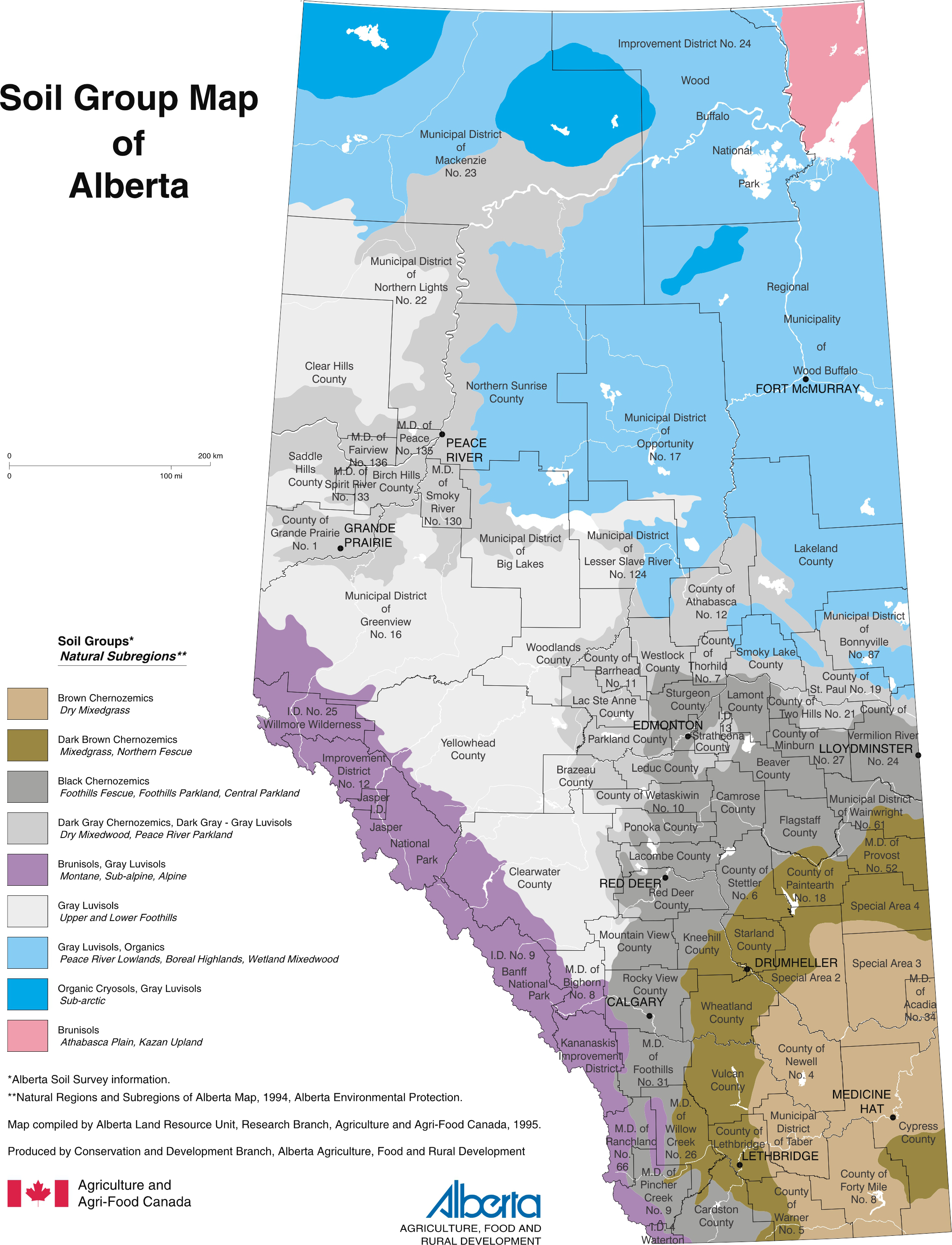
Soils in the Special areas
Brown Chernozemic Soils (Dominant)
Brown Chernozemic soils are the most common in the Special Areas, particularly in the driest regions where moisture conservation is a key challenge. These soils have low organic matter due to the semi-arid climate but are rich in essential mineral nutrients, making them suitable for grain and forage production. The limited water-holding capacity means that farming practices such as summer fallowing, minimum tillage, and snow trapping techniques are crucial to maintaining soil moisture. For instance, stubble retention and direct seeding have proven effective in reducing evaporation and improving yields. Crops such as wheat, barley, and canola perform well under these conditions, particularly when paired with drought-resistant varieties. Additionally, livestock grazing plays a vital role in maintaining soil health, as the integration of cattle or sheep helps manage crop residue while adding organic matter back into the soil.
Dark Brown Chernozemic Soils
Found in slightly wetter regions at the edges of the Special Areas, Dark Brown Chernozemic soils have higher organic matter content than their brown counterparts, allowing them to retain more moisture and support a broader range of crops. These soils are well-suited for wheat and canola production, benefiting from the improved fertility and water retention. Farmers in these areas often have better success with pulse crops such as lentils and peas, which contribute additional organic matter and help improve soil structure. In years with favorable precipitation, Dark Brown Chernozemic soils can produce higher yields compared to the Brown Chernozemic soils found in drier regions. Crop rotation, including legume-based cover crops, is an effective strategy for maintaining long-term productivity in these soils.
Solonetzic Soils
Solonetzic soils, sometimes referred to as "burnout" or "gumbo" soils, present significant challenges for cultivation due to their impermeable hardpan layer, which can range from 5 to 30 cm (2 to 12 inches) or more below the surface. This hardpan restricts root growth and limits water penetration, often leading to poor drainage and localized salinity issues. These soils are particularly difficult to manage for traditional row crops, as moisture and nutrients become inaccessible to shallow-rooted plants. However, strategic farming practices can improve productivity. Deep tillage or subsoiling can sometimes break up the hardpan, although it is not always a practical or long-lasting solution. Instead, planting deep-rooted crops such as alfalfa or salt-tolerant grasses like tall wheatgrass can gradually improve soil structure and reduce salinity over time. In pastures with Solonetzic soils, rotational grazing can help maintain soil health by preventing overgrazing and compaction. While these soils are more limiting, adaptive management strategies can still make them productive in mixed farming operations.
One of the most significant challenges in the Special Areas is managing soil moisture, as evapotranspiration rates consistently exceed annual precipitation. This means that the combined loss of moisture from soil evaporation and plant transpiration is greater than the amount of rainfall the region receives, leading to chronic soil moisture deficits. As a result, farmers must prioritize moisture conservation strategies to maintain crop and forage productivity. Without careful management, soils can dry out quickly, reducing yields and increasing the risk of wind and water erosion.
Compounding the issue, water infiltration rates are often low, particularly in areas with compacted or degraded soil layers. Heavy clay soils and those with a hardpan layer, such as Solonetzic soils, prevent water from soaking in effectively, leading to runoff rather than absorption. Even in sandy or loamy soils, repeated tillage and livestock trampling can lead to compaction, further reducing water infiltration. To counteract this, farmers use practices such as deep-rooted cover crops to break up compacted layers and improve soil structure. Additionally, contour farming, where crops are planted along the natural contours of the land, can slow water movement and allow more moisture to soak in.
To help retain soil moisture, many producers in the Special Areas have adopted conservation practices such as mulching, no-till farming, and organic matter management. Mulching with crop residues or straw helps reduce evaporation by covering the soil surface, keeping it cooler and protecting it from drying winds. No-till farming minimizes soil disturbance, which preserves soil structure, reduces compaction, and allows plant residues to act as a natural mulch. For example, direct seeding into standing stubble has been shown to improve moisture retention and promote healthier root development. Increasing organic matter through composting, manure application, and green manure crops also enhances the soil’s ability to hold water. For instance, incorporating legume cover crops such as clover or peas not only fixes nitrogen but also improves soil structure, allowing it to store more moisture for longer periods. By combining these strategies, farmers in the Special Areas can mitigate the effects of limited rainfall and ensure more sustainable crop and forage production.
Hydrology and Water Resources
Surface Water Availability
In the Special Areas, natural surface water sources are notably scarce and unreliable. Most of the small streams that do exist are seasonal, their flow heavily dependent on the melting of winter snow and the sporadic summer rains. This seasonal nature of water availability forces local farmers and ranchers to adopt alternative water management strategies. Dugouts and retention ponds have become essential components of the region's water infrastructure, capturing and storing precious water during brief periods of abundance. However, these man-made solutions require careful design and regular maintenance to minimize evaporation losses, a challenge compounded by the area's high winds and intense summer heat. As a result, effective water conservation practices are critical for sustaining agricultural and livestock operations in these arid, drought-prone landscapes.
Groundwater Resources
In addition to the challenges associated with surface water, groundwater availability in the Special Areas is highly variable. Some regions are fortunate enough to have access to shallow, reliable aquifers, while others rely on deeper, more costly well drilling to tap into groundwater sources. This variation in water availability adds complexity to water management practices, requiring farmers and ranchers to invest in infrastructure and technology to ensure a consistent supply. Furthermore, the water quality can be compromised by high salinity levels, which can significantly limit its suitability for irrigation and livestock use. Excessive salinity can harm plant growth and affect the health of animals, making it an ongoing concern for those dependent on well water. To address these challenges, well monitoring and conservation are critical components of sustainable water management in the region. Regularly testing water quality and implementing measures to reduce water waste are crucial for ensuring that groundwater resources are used responsibly and effectively, helping to safeguard water supplies for the long-term viability of agriculture and ranching in the Special Areas.
Groundwater availability in the Special Areas is highly variable, presenting additional challenges to water management in this arid environment. In some regions, water can be accessed from relatively shallow aquifers, but in many areas, the groundwater is stored in deep aquifers that require costly well drilling and specialized extraction techniques. Moreover, the quality of groundwater is often compromised by elevated salinity levels, which can significantly limit its use for irrigation and pose challenges for livestock consumption. Given these factors, rigorous well monitoring and the implementation of conservation practices are essential to manage this precious resource sustainably. Regular testing of water quality, coupled with careful management of extraction rates and soil salinity control measures, is critical for maintaining long-term water viability for both agricultural and livestock operations in the region.
Water Conservation Strategies
In the Special Areas, where water scarcity and variability are persistent concerns, innovative strategies are increasingly being adopted to supplement and manage available water resources. Rainwater harvesting and storage systems offer a valuable solution, allowing for the collection and storage of rainwater during wetter periods to be used during dry spells. This practice helps ensure that water resources are more evenly distributed throughout the year, reducing reliance on more unpredictable sources like seasonal streams or groundwater. At the same time, sustainable land management practices such as **rotational grazing** are implemented to preserve water use and prevent the overuse of pastureland. Rotational grazing allows land to recover between grazing cycles, maintaining healthy vegetation and improving water retention in the soil. Alongside this, efficient **irrigation systems** are crucial for optimizing water use, particularly in areas that do rely on irrigation for forage crops or other agricultural activities. These systems minimize waste and maximize the use of each drop of water. To enhance long-term productivity in this challenging climate, the introduction of **drought-resistant forage varieties** is a key strategy. These plants are specifically bred to require minimal water input while still providing adequate nutritional value over extended growing periods. By using these drought-tolerant forage crops, producers can maintain livestock productivity even during prolonged dry spells, ensuring sustainability in the face of ongoing water challenges. Collectively, these water-conservation techniques and agricultural innovations are vital for ensuring the resilience and viability of ranching and farming in the Special Areas. for 10 seconds
Rainwater harvesting and storage have become vital strategies in these arid regions, allowing farmers to capture and reserve water during brief periods of rainfall. This stored water supplements the limited natural sources, ensuring that there is a reserve to draw upon during dry spells. Complementing these efforts, rotational grazing practices help manage the pressure on the land by giving pastures time to recover, which in turn supports the natural water retention capacity of the soil. Efficient irrigation systems, such as drip or micro-irrigation, are also employed to minimize water waste by delivering precise amounts of moisture directly to plant roots. In addition to these techniques, the use of drought-resistant forage varieties ensures that crops and pasture lands remain productive even when water is scarce. These hardy varieties are specifically bred to thrive with minimal water input, securing long-term agricultural productivity and sustainability in the face of recurring droughts and fluctuating water availability.
Challenges and Adaptations for Agriculture in Alberta Special Areas
|
Challenge |
Impact |
Adaptive Strategy |
|
Low annual precipitation |
Limited crop growth and forage production |
Select drought-tolerant crops and forages |
|
High evaporation rates |
Moisture loss from soil and plants |
Cover cropping, mulching, and reduced tillage |
|
Short growing season |
Limited crop variety options |
Use short-season, early-maturing varieties |
|
Frequent drought cycles |
Crop failures and reduced livestock feed |
Drought planning, forage reserves, and irrigation efficiency |
|
Wind erosion |
Soil loss and degradation |
Shelter belts, zero-till farming, and residue retention |
|
Saline soils in some areas |
Poor crop performance |
Salt-tolerant crops and deep-rooted species |
|
Poor groundwater quality |
Limits irrigation and livestock water supply |
Water filtration, alternative water sources |
Conclusion: The Need for Climate-Adapted Farming Strategies
Successfully farming and ranching in Alberta’s Special Areas requires a deep understanding of the region’s unique climate and soil characteristics. With low annual precipitation, high evapotranspiration rates, and a short growing season, producers must adopt strategies that enhance resilience and efficiency. The combination of Brown and Dark Brown Chernozemic soils, along with challenging Solonetzic soils in some areas, means that careful soil management and crop selection are essential for long-term sustainability. By recognizing these environmental factors and working within their constraints, farmers can develop systems that thrive despite the challenges of dryland agriculture.
Water conservation is at the heart of sustainable farming in this region. Given the persistent soil moisture deficits, techniques such as no-till farming, mulching, and stubble retention are vital for preserving limited moisture. Additionally, efficient grazing management, such as rotational grazing and ensuring proper stocking rates, helps maintain soil cover and prevents excessive evaporation. Some producers have successfully implemented swales, snow fencing, and contour farming to capture and retain water where it is most needed. In cropland, practices like intercropping or planting drought-resistant cover crops can help improve soil moisture retention while also enhancing fertility.
Selecting appropriate crops and livestock further strengthens the resilience of farming systems in the Special Areas. Drought-tolerant grains such as durum wheat and barley perform well, as do oilseeds like canola and flax. Forage crops such as crested wheatgrass, alfalfa, and sainfoin are well-suited for grazing and hay production in low-moisture environments. Livestock operations benefit from hardy breeds that require minimal supplemental feed, such as Angus cattle or hair sheep like Dorper, which can thrive on native range. Producers raising sheep, bison, or mixed livestock find that well-managed pasture rotation allows them to maximize forage use while maintaining soil health.
Soil protection measures are equally important to ensure long-term productivity. Maintaining organic matter through composting, manure application, and the use of green manure crops improves soil structure and moisture retention. Shelter belts and windbreaks help reduce soil erosion and protect young crops from desiccating winds. In fields with Solonetzic soils, strategic planting of salt-tolerant grasses and deep-rooted forages can gradually improve soil permeability and reduce the impact of the hardpan layer. By integrating these practices, producers can sustain soil fertility and productivity even under harsh climatic conditions.
Ultimately, the key to success in the Special Areas lies in a proactive, adaptive approach. By combining water conservation techniques, careful crop and livestock selection, and soil management strategies, farmers and ranchers can mitigate the risks of dryland farming while optimizing yields and maintaining ecological balance. Those who adopt these practices are better positioned to endure drought cycles, reduce input costs, and sustain profitable operations in this demanding yet rewarding landscape.