
In dryland farming, crop rotation is one of the few management tools that remains completely under the farmer’s control. Rainfall cannot be controlled. Markets rise and fall without warning. Input costs seem to climb every year. But crop rotation—what goes where and when—is still a decision made at the farm table during the winter months.
That decision has long-term consequences. A good rotation improves soil structure, spreads economic risk, helps manage weeds and disease, and makes better use of limited moisture. A poor rotation may still produce a decent crop for a year or two, but eventually problems begin to surface. Disease pressure increases, fertility becomes harder to manage, weed issues multiply, and yields begin to flatten or decline. In the Alberta Special Areas and similar dryland regions, crop rotation is not simply an agronomic exercise. It is survival planning.
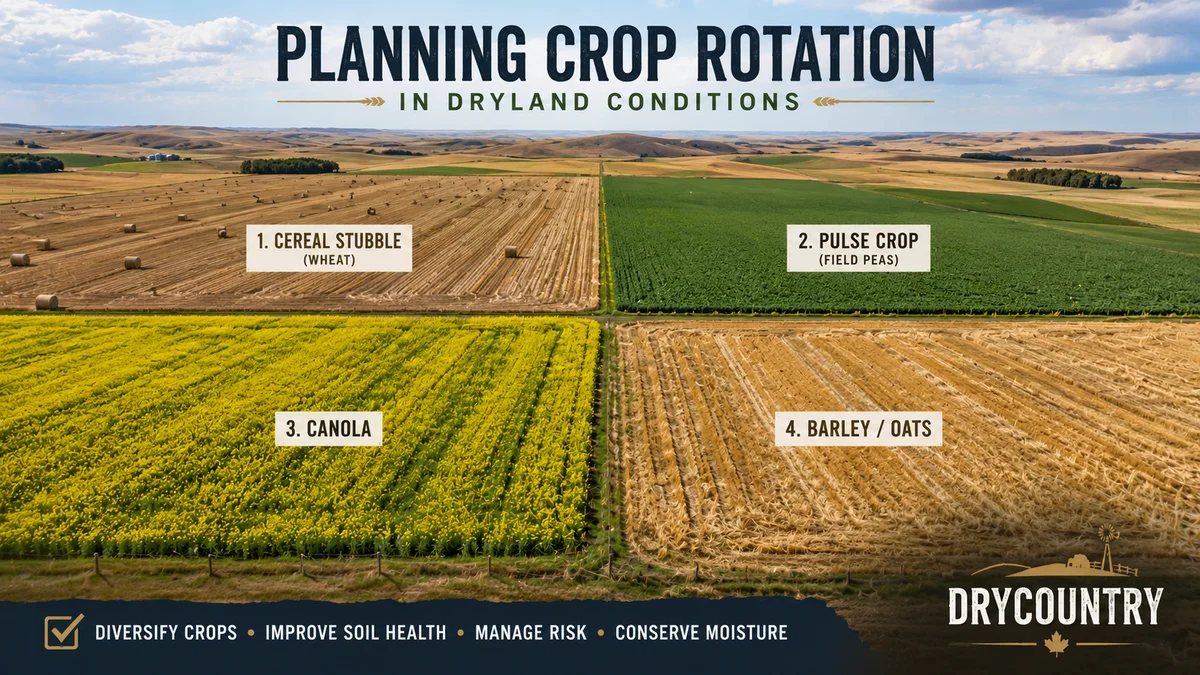 The challenge today is that financial pressure often pushes producers toward short-term thinking. When one crop performs well, the temptation is to expand acres dramatically the following year. Strong canola prices, for example, encourage more canola. High durum prices encourage tighter cereal rotations. While understandable, that approach often creates more problems than benefits over time.
In past times it was a general understanding that balance was the best approach to keeping the land fertile over many years of cropping. I remember my father usually has crop one year and fallow the next. The principal is something that still holds true today: balance matters. That does not mean farming exactly as previous generations did. Modern varieties, fertilizer practices, and equipment have changed agriculture significantly. But the principle remains the same. A healthy rotation spreads risk and keeps the land productive over the long haul.
The first consideration in planning a rotation is always moisture. In dryland farming, moisture is the foundation underneath every other decision. Different crops use moisture differently, and understanding those differences is critical. Deep-rooted crops can pull moisture from well below the surface, while others rely more heavily on near-surface reserves. Some crops leave more residue behind, helping conserve moisture for the following year. Others leave the soil more exposed.
This is where stubble management becomes part of the rotation discussion. Fields with good standing residue trap snow more effectively during winter. In the open prairie, snow trapped by standing stubble may provide a significant portion of the following year’s moisture reserve. Heavy tillage removes that advantage. While there are situations where tillage still has a place, excessive soil disturbance often creates more moisture loss than benefit in dryland regions. Residue also helps reduce evaporation during hot summer conditions. Bare soil loses moisture quickly, particularly during windy periods. Standing stubble shades the soil surface and slows that loss.
For many producers in dryland regions, cereals still form the backbone of the rotation for exactly this reason. Durum, spring wheat, barley, and oats tend to fit dryland conditions more consistently than some higher-risk crops. That does not mean other crops should be avoided, but cereals often provide stability within the rotation.
Canola presents a good example of balancing opportunity and risk. In favorable years, canola can be one of the more profitable crops on the farm. However, it is also one of the less forgiving crops under dry conditions. Shallow emergence, flea beetle pressure, and heat stress can quickly reduce yield potential when moisture is limited. In addition, tighter canola rotations increase disease concerns such as blackleg and clubroot. That does not mean canola should be avoided. It means acres should be managed carefully within the broader rotation plan.
Pulses introduce another set of advantages and challenges. Field peas, lentils, and chickpeas can contribute nitrogen to the soil and often reduce fertilizer requirements for following crops. They also help diversify herbicide options and break disease cycles associated with cereals. However, pulses can be sensitive to both drought stress and excessive moisture at harvest. In some areas of the Special Areas, they fit very well. In others, they remain a higher-risk option. Again, balance is the key.
There is also the question of fertilizer management within the rotation. Different crops leave behind different nutrient profiles. A cereal crop following pulses may require less nitrogen. Conversely, high-yielding cereal crops can significantly reduce available nutrients for the following season. Understanding these patterns helps improve fertilizer efficiency and control costs.
Soil testing becomes extremely important here. Many producers still rely partly on experience and visual assessment when planning fertility, and experience certainly matters. But fertilizer costs today are too high for guesswork alone. Soil testing provides a clearer picture of nutrient levels and allows more accurate planning. At the same time, fertilizer decisions must remain tied to realistic moisture expectations.
One of the costly procedures during dry cycles is fertilizing for yields that available moisture simply cannot support. High fertilizer rates may look good on paper, but without moisture the crop cannot fully utilize those nutrients. Matching fertility to realistic yield goals often improves profitability more than pushing for maximum production every year.
Weed management also plays a major role in crop rotation planning. Different crops allow for different herbicide groups and timing options. Rotating crops helps prevent weeds from adapting to a single control program. Herbicide resistance has become a growing issue across western Canada, and once resistance develops, control options become limited and expensive. A diverse rotation is one of the simplest tools available to slow that process. Certain crops also compete with weeds more effectively than others. Barley, for instance, tends to establish quickly and provide strong competition. Slower-establishing crops may require more aggressive weed control strategies.
Disease management is equally important. Continuous cereals increase the risk of diseases such as tan spot and fusarium. Tight canola rotations increase blackleg concerns. Pulse crops bring their own disease pressures as well. Rotation helps interrupt those disease cycles naturally, reducing reliance on chemical controls. That becomes increasingly important as fungicide costs continue to rise.
If all this wasnt enough there is also an equipment and labor consideration that sometimes gets overlooked. Different crops spread workload across the season. Seeding dates vary slightly, spraying windows differ, and harvest timing changes from crop to crop. A more balanced rotation reduces pressure during peak periods and allows machinery and labor to be used more efficiently. For mixed farming operations, rotation planning often extends beyond grain production alone.
Feed requirements for cattle may influence crop choices. Oats, barley, greenfeed, silage, or hay acres may all be included as part of the broader farm plan. In difficult moisture years, having flexibility between grain and feed production can become extremely valuable. This is one area where mixed operations often maintain an advantage over highly specialized farms. Livestock provide another outlet for lower-quality crops or drought-affected feed that might otherwise represent a total loss.
Economics, of course, remain part of every decision. No farmer can ignore markets entirely. Profitability matters. But chasing last year’s highest-priced crop too aggressively often creates instability. The most successful operations usually aim for consistent profitability rather than occasional exceptional years followed by poor ones. Consistency rarely makes headlines, but it keeps farms operating over generations.
There is also value in simplicity. Complex rotations with numerous crop types may look excellent on paper, but they also increase management demands. Different fertilizer requirements, spraying schedules, storage considerations, and marketing plans all add complexity. Each operation must find a level of diversity that remains manageable.
For some farms, a three- or four-crop rotation may be ideal. Others may successfully manage more diversity. The important thing is having a system that fits the land, moisture conditions, labor availability, and management style of the operation.
Long-term soil health should never be ignored in the process. Healthy soil holds moisture better, supports stronger root systems, and withstands stress more effectively. Rotation contributes directly to maintaining that health. Organic matter, residue levels, and biological activity all respond to cropping practices over time. The effects are not always immediate, but they become obvious over decades.
That may be one of the biggest differences between short-term farming and long-term stewardship. The land responds to how it is managed year after year. Winter is often when these decisions are made, sitting around the kitchen table with yield maps, rainfall records, market reports, and seed guides spread out across the surface. There is always uncertainty involved. No one knows exactly what kind of year lies ahead.
But careful planning still matters. Good rotations do not eliminate risk. Nothing in dryland farming does. What they do is improve the odds. They help stabilize production, protect soil health, and reduce the impact of difficult years. In the dry country, where moisture is limited and conditions can change quickly, improving the odds is often the best a farmer can do. Like many things in agriculture, crop rotation is not built around chasing perfection. It is built around managing reality as wisely as possible.
The farms that remain productive generation after generation are rarely the ones that chased every trend or every short-term opportunity. More often, they are the operations that stayed balanced, adapted carefully, and respected the limitations of the land they farmed.
That lesson has not changed much over the years, and it still applies today.